


Hello and welcome to Episode 98 of Read Paradise Lost with me, Jane Davis, a podcast and Substack newsletter about my project to read all of Paradise Lost by John Milton, aloud, and with a sometimes word-by-word, sometimes line-by-line discussion. This is a one-take recording with no editing, so forgive noise of seagulls, my coughing, or sound of men drilling next door. Rough and ready reading is what you get.
This week we begin Book 9, reading the opening 100 lines.
NO more of talk where God or Angel Guest
With Man, as with his Friend, familiar us’d
To sit indulgent, and with him partake
Rural repast, permitting him the while
Venial discourse unblam’d: I now must change [ 5 ]
Those Notes to Tragic; foul distrust, and breach
Disloyal on the part of Man, revolt,
And disobedience: On the part of Heav’n
Now alienated, distance and distaste,
Anger and just rebuke, and judgement giv’n, [ 10 ]
That brought into this World a world of woe,
Sinne and her shadow Death, and Miserie
Deaths Harbinger:
This is the fourth of Milton’s invocations (the others being BkI 1-49, III 1-55, VII 1-50) but unlike those others, here Milton seems to be addressing us, or himself, rather than the Muse. No need to call for divine inspiration here? We all know what is to come.
That happy period where Man could talk direct with God or Angel is done; ‘I now must change/ Those Notes to Tragic’.
I notice all the words beginning with ‘dis’ - distrust, disloyal, disobedience (for Man) and distance and distaste (for Heaven) - the prefix ‘dis’ come from an indo- european root *dwo- "two."and in English it reverses or negatives what it is affixed to’ The very language tells us ‘split’ and ‘reversals’.
Milton, musing on his task begins with questions about what ‘the heroic’ is:
Sad task, yet argument
Not less but more Heroic then the wrauth
Of stern Achilles on his Foe pursu’d [ 15 ]
Thrice Fugitive about Troy Wall; or rage
Of Turnus for Lavinia disespous’d,
Or Neptun‘s ire or Juno‘s, that so long
Perplex’d the Greek and Cytherea‘s Son;
If answerable style I can obtaine [ 20 ]
Of my Celestial Patroness, who deignes
Her nightly visitation unimplor’d,
And dictates to me slumb’ring, or inspires
Easie my unpremeditated Verse:
Since first this Subject for Heroic Song [ 25 ]
Pleas’d me long choosing, and beginning late;
Not sedulous by Nature to indite
Warrs, hitherto the onely Argument
Heroic deem’d, chief maistrie to dissect
With long and tedious havoc fabl’d Knights [ 30 ]
In Battels feign’d; the better fortitude
Of Patience and Heroic Martyrdom
Unsung; or to describe Races and Games,
Or tilting Furniture, emblazon’d Shields,
Impreses quaint, Caparisons and Steeds; [ 35 ]
Bases and tinsel Trappings, gorgious Knights
At Joust and Torneament; then marshal’d Feast
Serv’d up in Hall with Sewers, and Seneshals;
The skill of Artifice or Office mean,
Not that which justly gives Heroic name [ 40 ]
To Person or to Poem.
I give you that long section so you can have a run at it and get the gist, but it is probably necessary to break it down. My work, Milton says, is more heroic than The Iliad. What he needs help with is not subject matter but style, which is the help he seeks from his muse, ‘my Celestial Patroness’, who, he explains
deignes
Her nightly visitation unimplor’d,
And dictates to me slumb’ring, or inspires
Easie my unpremeditated Verse.
Readers on the online Shared Reading group were shocked by or perhaps sceptical about Milton’s assertion that his verse is ‘unpremeditated.’ He tells us that he receives the poem nightly while asleep, and we know from biographical matter that Milton woke early and needed to dictate what had come to him. An amanuensis would write down what he dictated and later read it back to him so he could edit it - by dictation again.
‘Easie’? ‘Unpremeditated’? And yes, in some ways, yes. What what a relief to a man (‘beginning late’) who must have thought that his great poem was at best unlikely, at worst an impossibility. Here it is, night after night, coming into his mind.
Now he offers more indications of what he can do and what has not been done: he might have written about Wars, it could have be a chivalrous romance; ‘emblazon’d Shields,/Impreses quaint, Caparisons and Steeds;/Bases and tinsel Trappings, gorgious Knights/At Joust and Torneament.’
Mee of these
Nor skilld nor studious, higher Argument
Remaines, sufficient of it self to raise
That name, unless an age too late, or cold
Climat, or Years damp my intended wing [ 45 ]
Deprest, and much they may, if all be mine,
Not Hers who brings it nightly to my Ear.
Is this a moment of wobble, is he doubting himself, his capability? I imagine he must have suffered and felt those feelings as his sight diminished, as the revolution faltered, the war was lost, and years passed without him producing the Great Work. Is the world you inhabit a likely place for a great heroic poem? Is the way life has panned out for you conducive to greatness in poetry?
And yet he does it! He may not be ‘skilled nor studious’ in poetry (another dubious claim, because of course he is extremely skilled, and has been since his teens), but it’s true, he does have ‘higher Argument’ and unless knocked off course by his age or the age, or ‘cold climat’ or ‘years’, he intends to bring the poem to be, is indeed, here at Book 9 bringing it to the highest peak of tragedy. If it is a wobble, it is one which attends to itself and resolves its difficulties. At line 48 he is able to restart the story, and as he does, we go into a movie-like cosmic-wonder-show, watching Satan buzz round the planet;
The Sun was sunk, and after him the Starr
Of Hesperus, whose Office is to bring
Twilight upon the Earth, short Arbiter [ 50 ]
Twixt Day and Night, and now from end to end
Nights Hemisphere had veild the Horizon round:
When Satan who late fled before the threats
Of Gabriel out of Eden, now improv’d
In meditated fraud and malice, bent [ 55 ]
On mans destruction, maugre what might hap
Of heavier on himself, fearless return’d.
Here he is ‘now improved’ / (wonderful line ending! ) ‘in meditated fraud and malice.’ Readers were moved and appalled by Satan’s plight - to have such clear self-awareness, while being so bad.
By Night he fled, and at Midnight return’d.
From compassing the Earth, cautious of day,
Since Uriel Regent of the Sun descri’d [ 60 ]
His entrance, and forewarnd the Cherubim
That kept thir watch; thence full of anguish driv’n,
The space of seven continu’d Nights he rode
With darkness, thrice the Equinoctial Line
He circl’d, four times cross’d the Carr of Night [ 65 ]
From Pole to Pole, traversing each Colure;
Satan flees daylight, ‘cautious of day’, riding ‘with darkness’ as the planet turns and night moves across the face of the planet, a sort of mania, it feels, as he buzzes about, fast and furious:
On the eighth return’d, and on the Coast averse
From entrance or Cherubic Watch, by stealth
Found unsuspected way. There was a place,
Now not, though Sin, not Time, first wraught the change, [ 70 ]
Where Tigris at the foot of Paradise
Into a Gulf shot under ground, till part
Rose up a Fountain by the Tree of Life;
In with the River sunk, and with it rose
Satan involv’d in rising Mist, then sought [ 75 ]
Where to lie hid;
This is how to sneakily cause ruin: inhabit the changing flex of water into mist. Remember - was it in Book 4 we noticed brooks in Paradise wandering ‘in mazy error’? - still lovely and unfallen that Paradise yet, containing something to which the noun ‘error’ might be attached. Water, not fixed, not solid, and likely to transmute. Just what Satan needs.
And he is prepared for this new state of misty wiliness. He has prepared for it, and we see how world-wide has been his thrumming search for the vessel he seeks:
Sea he had searcht and Land
From Eden over Pontus, and the Poole
Mæotis, up beyond the River Ob;
Downward as farr Antartic; and in length
West from Orontes to the Ocean barr’d [ 80 ]
At Darien, thence to the Land where flowes
Ganges and Indus: thus the Orb he roam’d
With narrow search; and with inspection deep
Consider’d every Creature, which of all
Most opportune might serve his Wiles, and found [ 85 ]
The Serpent suttlest Beast of all the Field.
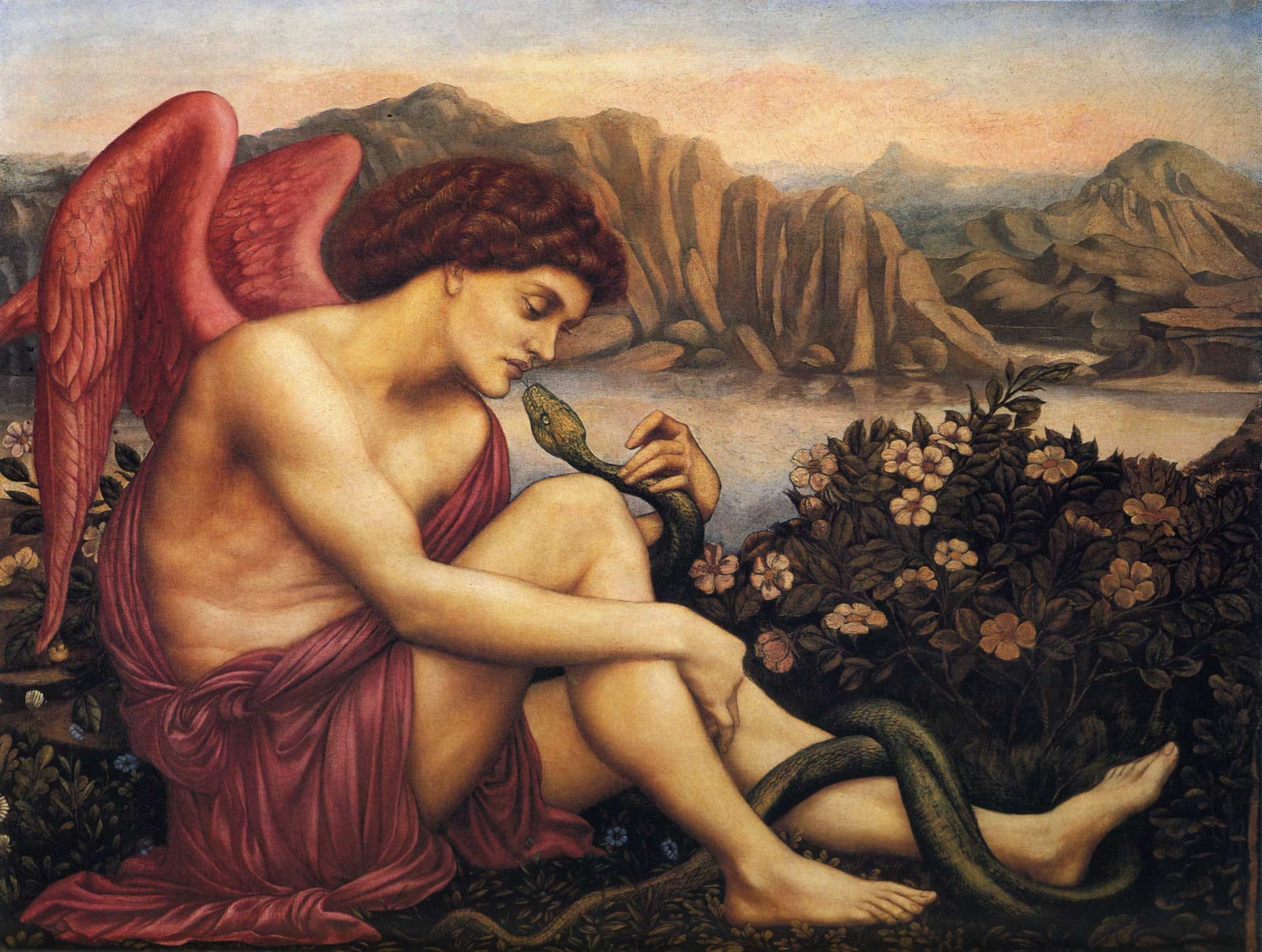
What does ‘suttlest’ really mean here? If I look back to Genesis 3.1 ( for the phrase, "Now the serpent was more subtil [subtlest] than any beast of the field’ ) I’m assuming it means something like ‘tricky’, and when I look up the original Hebrew I find the word is 'aruwm, meaning a sharp-mindedness or shrewdness.If you work through a creature known for sharp-mindedness it won’t seem jarring when he turns out to be a great arguer.
My mind goes through a few circling thoughts -
Q: Why did God create a serpent anyway?
A: we can’t know that, only that there is a serpent and it is subtle
Q: Is there always a vehicle waiting for bad intent?
A: Seems so, once the bad intent is searching for a way through.
Q: What kind of place is this creation with the possibility of things always likely to go wrong, fall off?
A: It is the kind of creation we live in
Q: that makes me query God’s ability to create well
A: Well, Milton has written his poem to help you understand ‘the ways of God.’ Just keep reading.
Whatever the reason for the existence of such a creature, Satan at length resolves to use him:
Him after long debate, irresolute
Of thoughts revolv’d, his final sentence chose
Fit Vessel, fittest Imp of fraud, in whom
To enter, and his dark suggestions hide [ 90 ]
From sharpest sight: for in the wilie Snake,
Whatever sleights none would suspicious mark,
As from his wit and native suttletie
Proceeding, which in other Beasts observ’d
Doubt might beget of Diabolic pow’r [ 95 ]
Active within beyond the sense of brute.
Thus he resolv’d, but first from inward griefe
His bursting passion into plaints thus pour’d:
But we must wait until next time to hear what it is that burst forth from Satan’s ‘inward grief’ as he puts his diabolical plan in to action. But it is sad and sorry to have to note that Satan as he approaches his worst act yet is doing it out of ‘inward grief’.
So important to get that sort of thing straight. Why can’t he just repent, cried a reader in the online group.
More next week.


