


Hello and welcome to Episode 96 of Read Paradise Lost with me, Jane Davis, a podcast and Substack newsletter about my project to read all of Paradise Lost by John Milton, aloud, and with a sometimes word-by-word, sometimes line-by-line discussion. This is a one-take recording with no editing, so forgive noise of seagulls, my coughing, or sound of men drilling next door. Rough and ready reading is what you get.
Last week we finished at Book 8, line 479, where Adam woke to find his dream of Eve disappearing. This week we’ll read nearly 100 lines, to Book 8, line 559.
In the online Shared Reading group we talked about the strange dream-state of Adam, dreaming waking dreaming waking with the same activity going on in both sleep and wakefulness. We talked about Milton’s composing (inspired while asleep by the Heavenly Muse, waking to write) and how his own experiences must have been the background to this unusual flexi-consciousness.
As here, in these opening lines, where she is gone, leaving Adam ‘dark’, waking ‘to find her’, and then fully awake - he does find her:
Shee disappeerd, and left me dark, I wak’d
To find her, or for ever to deplore
Her loss, and other pleasures all abjure: [ 480 ]
When out of hope, behold her, not farr off,
Such as I saw her in my dream, adornd
With what all Earth or Heaven could bestow
To make her amiable: On she came,
Led by her Heav’nly Maker, though unseen, [ 485 ]
And guided by his voice, nor uninformd
Of nuptial Sanctitie and marriage Rites:
Grace was in all her steps, Heav’n in her Eye,
In every gesture dignitie and love.
I overjoyd could not forbear aloud. [ 490 ]
A reader pointed out how partial Adam’s account is here - we know from Book 4 that Eve has been diverted from narcissistic self-love (seeing herself in the water) by God, and that when she first sees Adam, Eve does not find him as attractive as the creature in the water. Adam only sees loveliness coming toward him.
This turn hath made amends; thou hast fulfill’d
Thy words, Creator bounteous and benigne,
Giver of all things faire, but fairest this
Of all thy gifts, nor enviest. I now see
Bone of my Bone, Flesh of my Flesh, my Self [ 495 ]
Before me; Woman is her Name, of Man
Extracted; for this cause he shall forgoe
Father and Mother, and to his Wife adhere;
And they shall be one Flesh, one Heart, one Soule.
Adam’s pleasurable cry of thanks also - some readers thought - contains a hint of self-love. Adam says he sees ‘Bone of my Bone, Flesh of my Flesh, my Self /
Before me;’ and we discussed the idea of seeing oneself - or parts of oneself, or the missing parts of of oneself - in others.
She heard me thus, and though divinely brought, [ 500 ]
Yet Innocence and Virgin Modestie,
Her vertue and the conscience of her worth,
That would be woo’d, and not unsought be won,
Not obvious, not obtrusive, but retir’d,
The more desirable, or to say all, [ 505 ]
Nature her self, though pure of sinful thought,
Wrought in her so, that seeing me, she turn’d;
I follow’d her,
This the moment we have seen before, in Book 4, as Eve recounts her earliest memories to Adam:
I espi'd thee, fair indeed and tall,
Under a Platan, yet methought less faire,
Less winning soft, less amiablie milde,
Then that smooth watry image; back I turnd, [ 480 ]
Thou following cryd'st aloud, Return faire Eve,
Whom fli'st thou? whom thou fli'st, of him thou art,
His flesh, his bone; to give thee being I lent
Out of my side to thee, neerest my heart
Substantial Life,
Anyone would prefer, it seems, woman to man.
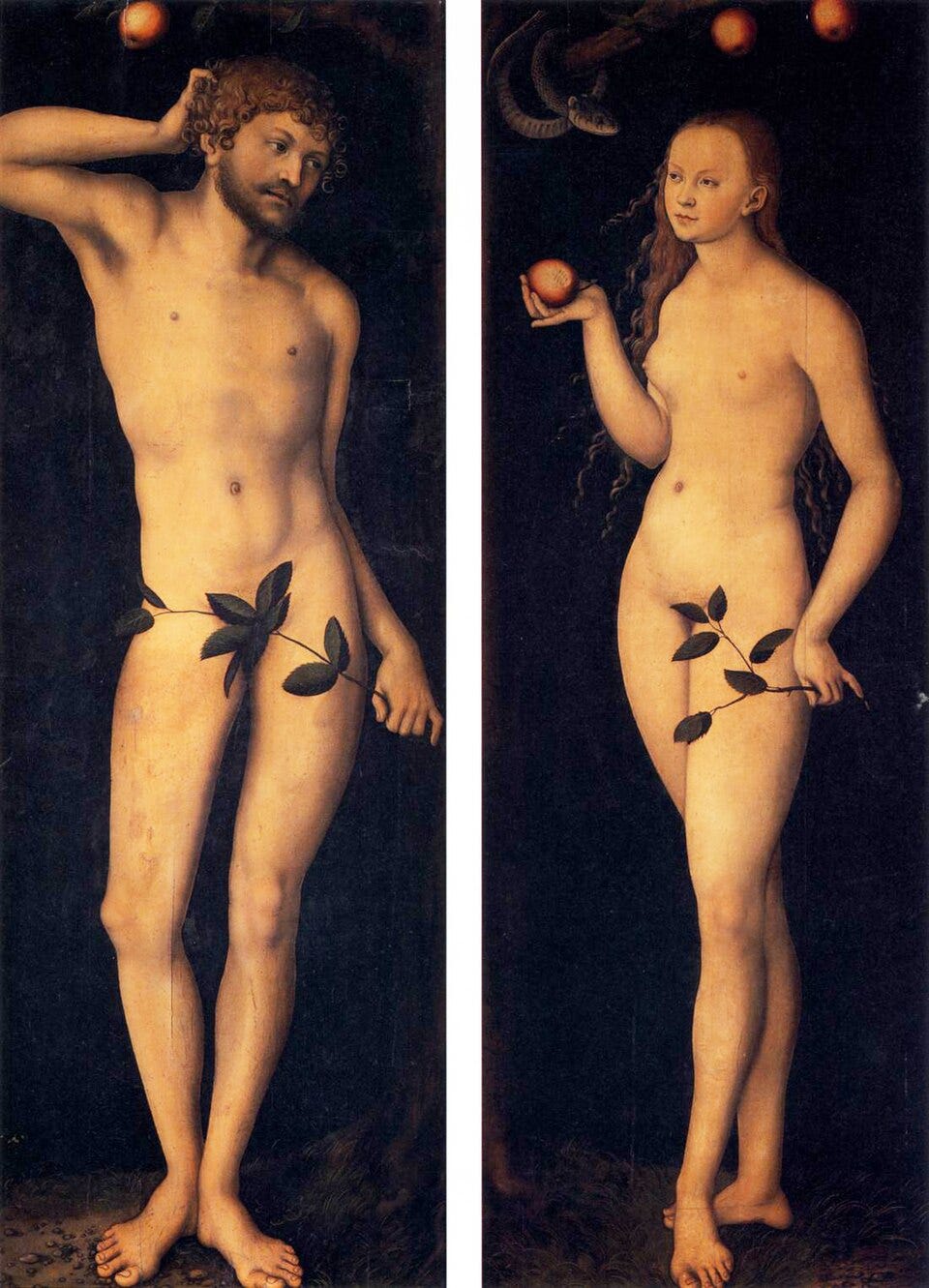
But Eve is amenable to Adam’s argument (‘my pleaded reason’) and goes with him to the nuptial bower, where we feel the universal earth-moving effects of the first act of human sexual intercourse:
she what was Honour knew,
And with obsequious Majestie approv’d
My pleaded reason. To the Nuptial Bowre [ 510 ]
I led her blushing like the Morn: all Heav’n,
And happie Constellations on that houre
Shed thir selectest influence; the Earth
Gave sign of gratulation, and each Hill;
Joyous the Birds; fresh Gales and gentle Aires [ 515 ]
Whisper’d it to the Woods, and from thir wings
Flung Rose, flung Odours from the spicie Shrub,
Disporting, till the amorous Bird of Night
Sung Spousal, and bid haste the Eevning Starr
On his Hill top, to light the bridal Lamp. [ 520 ]
What utter and natural joy. Hurrah for Milton.
Adam seems to pause here, at this highest point, and then come back to earth in the telling of his story to Raphael.
Thus I have told thee all my State, and brought
My Storie to the sum of earthly bliss
Which I enjoy, and must confess to find
In all things else delight indeed, but such
As us’d or not, works in the mind no change, [ 525 ]
Nor vehement desire, these delicacies
I mean of Taste, Sight, Smell, Herbs, Fruits and Flours,
Walks, and the melodie of Birds; but here
Farr otherwise, transported I behold,
Transported touch; here passion first I felt, [ 530 ]
Commotion strange, in all enjoyments else
Superiour and unmov’d, here onely weake
Against the charm of Beauties powerful glance.
Why do not other joys affect me in the same way, Adam wonders? No other form of ‘earthly bliss’ affects him so. They ‘work in the mind no change/
Nor vehement desire’. But Eve, woman, and physical contact with her ignites ‘commotion strange’ and he knows he is ‘weake/Against the charm of Beauties powerful glance.’
This is worrying, we know it and Adam knows it too, trying to understand how such weakness is in him:
Or Nature faild in mee, and left some part
Not proof enough such Object to sustain, [ 535 ]
Or from my side subducting, took perhaps
More then enough; at least on her bestow’d
Too much of Ornament, in outward shew
Elaborate, of inward less exact.
He knows this, even as he also knows that Eve is ‘th’ inferior’ in terms of mind and even he thinks outwardly, she less resembles God, and she has less of the authority of ‘dominion’
For well I understand in the prime end [ 540 ]
Of Nature her th’ inferiour, in the mind
And inward Faculties, which most excell,
In outward also her resembling less
His Image who made both, and less expressing
The character of that Dominion giv’n [ 545 ]
O’re other Creatures;
So there’s a hierarchy, and it is ‘he for God only, she for God in him’ (Book 4 line 299) and yet… something about Eve’s loveliness and Adam’s (shall I say) subjection to it, undermines that hierarchy. As Adam himself knows:
yet when I approach
Her loveliness, so absolute she seems
And in her self compleat, so well to know
Her own, that what she wills to do or say,
Seems wisest, vertuousest, discreetest, best; [ 550 ]
All higher knowledge in her presence falls
Degraded, Wisdom in discourse with her
Looses discount’nanc’t, and like folly shewes;
Authority and Reason on her waite,
As one intended first, not after made [ 555 ]
Occasionally; and to consummate all,
Greatness of mind and nobleness thir seat
Build in her loveliest, and create an awe
About her, as a guard Angelic plac’t.
Oh dear. That awe he feels - even as he knows she is not wiser than him - is his undoing now, even before the fall - oh, poor Adam:
All higher knowledge in her presence falls
Degraded, Wisdom in discourse with her
Looses discount’nanc’t, and like folly shewes;
‘Falls’, ‘degraded’, ‘folly’. And that is before the Fall.
Why does God - such a great and wondrous creator - make these flawed creatures?
Satan, Adam, Eve - they all come with flaws, inner failings, brokennesses… The greater narrative of the poem (and of Milton’s Christianity) tells us that these flaws only lead to greater displays of goodness and love (‘all of his malice served but to bring forth/Infinite goodness, grace and mercy…Book 1 , line 217) and that the Fall is necessary to the redemption by Christ. That seems a circular argument to me, though I’d be careful about saying that in conversation with Milton, because I have the feeling he starts in a different place.
For me what Milton calls ‘God’ is the creative energy of the cosmos. That creative energy makes, and is, everything and that ‘everything’ includes flaws, breakages, things going wrong. Such things (Satan’s pride, Adam’s sexual besottment) are part of the cosmic mix. There are flaws everywhere: seedling deforming bacteria, evil conditions that shape up murderers, the selfish worried meannesses that make us unkind or ungenerous to our neighbours, stars exploding, moulds which cause human illness.
I do feel that part of the cosmic energy is love - generous and selfless as it can be, self-ish or self-sustaining as it often is. Wonderfully and powerful. And yet I do not feel that love finally shapes the pattern of the cosmos, which seems to me odder and more multifarious than that. So I am not a Christian. I’m with Einstein - I adore the creation and I am grateful for my life, but I’m an ignorant child of the universe who can hardly get through the cosmic library door, let alone read the languages the books are written in.
I try to read the book of life by observing it, and by reading strong literature (which is a kind of observation) and seeing what bigger minds than mine have observed and what they have made of it. Hence, I love Paradise Lost, one of the biggest attempts at thinking it all through, ever. Though, as I said in the online Shared Reading group last week, not perfect. Milton can be clunky, I said, shocking the group into nervous laughter, as previously I’ve always defended him to the death.
But I love the poem more than ever now, after having been reading it like this for two years. Perhaps with that love comes confidence to admit the flaws. Perhaps that’s what Milton’s God is doing when he makes the whole cosmic pattern circular.
As the pragmatists/anti-perfectionists say ‘Done is better than perfect.’
More next week.


